







How Torsion Springs Work
How do torsion springs work?
Torsional springs exert a radial force. Their “legs” are rotated thus winding/twisting the springs coils.

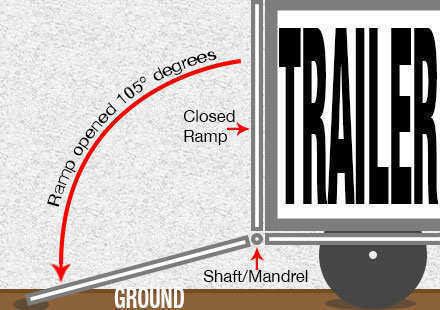
Torsion springs work in many applications. You can find these in doors, lids, hatches, and even trailer ramps. Their function is to exert a radial force. Meaning this spring doesn’t travel in a linear/vertical/horizontal manner, but in a rotational/curved manner. They are used in these sort of applications because that is exactly how these applications work. Doors, lids, hatches, and trailer ramps move in a radial/rotational manner.
The torque and deflection a torsional spring is able to provide is based on its physical dimensions. Given the number of coils and the tightness of such coils, your spring has a spring rate per degree. Using the spring rate per degree you’re able to calculate how much torque you will need at a certain distance traveled as well as how much travel your spring will achieve under a certain torque.
To calculate how much torque your spring will need to meet a desired degrees of deflection, you will need to multiply the desired degrees of deflection by the spring rate. The product of this calculation is the torque you will need in order to meet that requirement given the torsion spring’s rate per degree.
On the other hand, to calculate the degrees of deflection you will accomplish with a certain amount of torque, you must divide that torque by the rate per degree. The result of this calculation will tell you exactly how many degrees of travel the spring will deflect under that specific load.